I.About Us
i.Shanghai Textile Industry Workers’ College
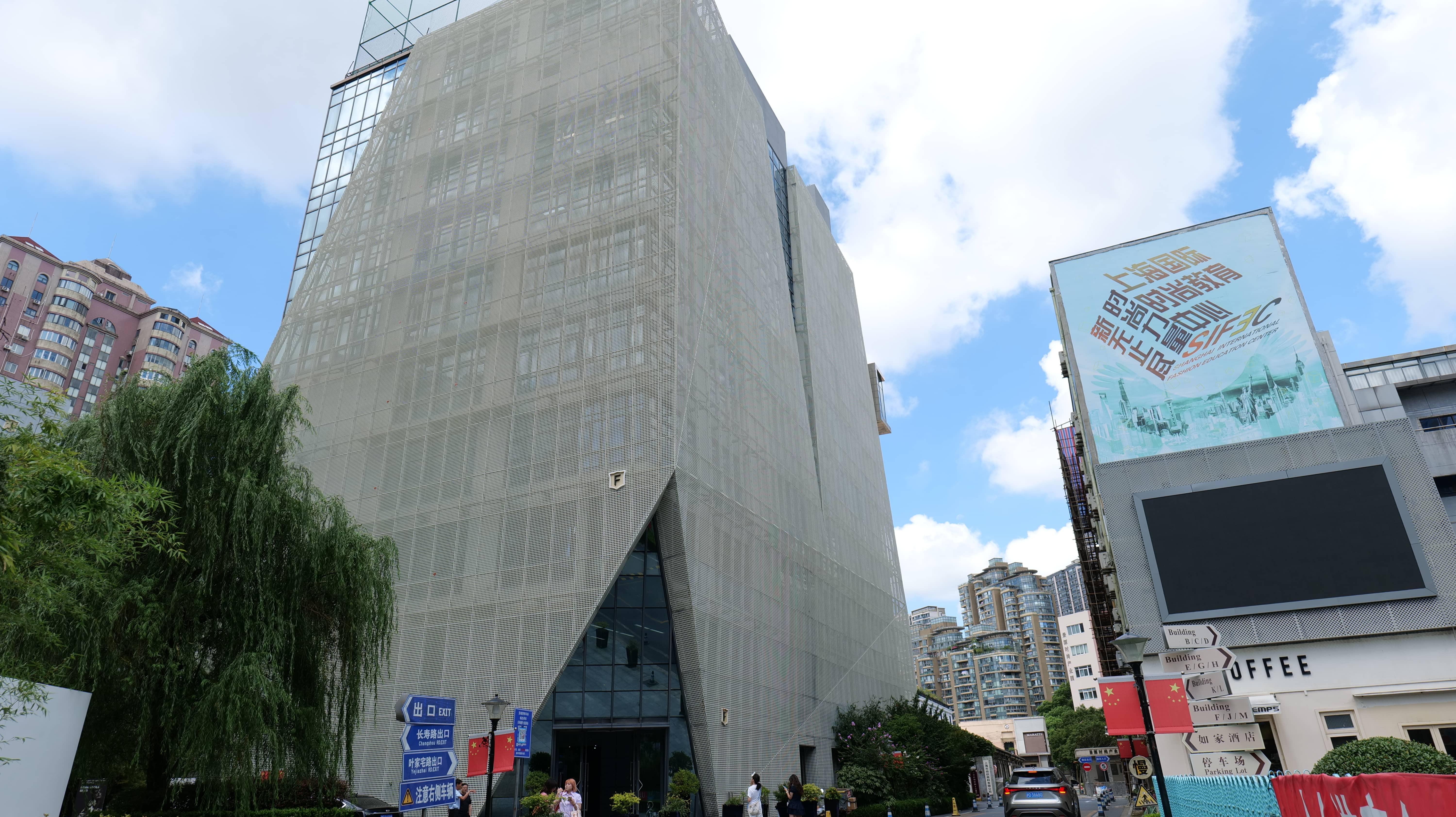
Founded in 1955, SIFEC (Shanghai International Fashion Education Center) is a government-approved adult college specializing in Economic Management, Engineering Technology, and Art & Design. Located by Suzhou Creek, it offers four diploma programs and is authorized to enroll international students with study visas. Affiliated with Orient International (Holding) Co., Ltd., SIFEC leverages the group's industry chain to build its fashion education brand. It is an IFFTI member and maintains global partnerships with institutions like Istituto Marangoni, Parsons, and MOD'SPE, alongside local industry associations.
ii.Sydney Polytechnic Institute
Sydney Polytechnic Institute (SPI) is a higher education provider registered and accredited by the Tertiary Education Quality and Standards Agency (TEQSA), with its bachelor's and master's degrees recognized as nationally accredited qualifications within the Australian higher education system. As an emerging institution within Australia's higher education landscape dedicated to digital technology and applied talent development, SPI adheres to the core educational philosophy of "Application-oriented, Industry-focused and Globally relevant" committed to delivering high-quality Australian higher education that is closely aligned with industry development.
iii.History and Scale
Sydney Polytechnic Institute (SPI) is a TEQSA-accredited and CRICOS-registered higher education provider located in Sydney CBD. Specializing in the application of knowledge to business and society, SPI offers undergraduate and postgraduate programs in Artificial Intelligence, Data Science, Software Engineering, Cybersecurity, and Digital Marketing. The institute is governed by an international board, with core members and academic leaders hailing from top-tier global universities and executives possessing extensive industry experience.
iv.Industry-Education Integration and Applied Talent Development System
SPI aligns its applied talent cultivation with global digital economy trends through its "Industry Integrated Learning" philosophy. The institute embeds real industry projects into its curriculum via project-based learning, enterprise practice, and career support.
Backed by a strong network of industry partners, SPI collaborates across AI, cybersecurity, and digital innovation to co-develop curricula and provide internship placements. Students gain over 800 hours of practical experience in real-world projects, effectively bridging the gap between academia and industry. This model significantly enhances students' professional competencies and employability.
II.Program Overview
Shanghai Textile Industry Workers' College and Sydney Polytechnic Institute have jointly established the Shanghai Campus to offer the Bachelor of Computing (3+0) undergraduate program. Students complete the entire three-year program at the Shanghai Campus, receiving the same educational resources and teaching quality as the Sydney campus, and upon graduation, receive the Bachelor of Computing degree conferred by Sydney Polytechnic Institute.
Program Highlights:
·“3+0” Model, Complete Australian Curriculum in China: No need to study abroad—students complete all three years at the Shanghai Campus and receive a degree equivalent to that awarded at the Australian campus upon completing the required credits.
·Opportunity to Study in Australia: Students may choose to transfer to Australia to continue their studies, subject to the relevant academic and Australian Government visa requirements.
·Authentic Australian Curriculum: Course structure, teaching content, and assessment standards are aligned with those of the Sydney campus, with joint instruction delivered by both Chinese and Australian faculty.
·Excellent Value: Significant savings on tuition and living expenses compared to direct study in Australia, while receiving the same quality of education.
III.Program Specialisations
This program offers training in three career role specialisations. During their studies, students may select one or two specialisations based on their career goals and personal interests. Upon graduation, students may choose whether to have their chosen specialisation indicated on the degree certificate (by default, the degree awarded is Bachelor of Computing).
i.Bachelor of Computing (Role specialisation: Artificial Intelligence Engineer)
Become an Artificial Intelligence Engineer and learn to design, develop, and deploy intelligent systems powered by machine learning, data science, predictive analytics, and automation technologies. Gain practical experience in artificial intelligence, deep learning, natural language processing, and AI-driven software development while preparing for high-demand careers in Australia's rapidly growing technology sector.
ii.Bachelor of Computing (Role specialisation: Cyber-security Engineer)
Become a Cyber Security Engineer and learn to protect organisations from cyber threats, ransomware attacks, data breaches, and evolving security risks. Develop expertise in information security, ethical hacking, network security, cloud security, digital forensics, and secure software development while preparing for in-demand cybersecurity careers in Australia and globally.
iii.Bachelor of Computing (Role specialisation: Software Engineer)
Become a Software Engineer and learn to design, build, test, and maintain modern software systems that power businesses and digital services worldwide. Develop practical expertise in software development, cloud computing, web technologies, mobile applications, databases, DevOps, and enterprise software engineering while preparing for high-demand technology careers.
*Upon graduation, students may choose whether to have their specialisation indicated on the degree certificate.
IV.Program Structure and Learning Approach
The program adopts the same innovative curriculum as the Sydney campus, consisting of three parallel streams:
i.Core Units Stream: Through systematic study of core knowledge in Computer Science and Software Engineering, students will develop professional competencies in programming, data structures and algorithms, databases, networking, software engineering, artificial intelligence, and cybersecurity, laying a solid foundation for future careers in technology development, software engineering, and related digital technology fields.
ii.Career Pathways Stream: Students are required to complete elective modules that support the mock consultancy projects while aligning with students' interests and career goals.
iii.Mock Consultancy Stream: Students are embedded into a simulated professional IT consulting company, progressing through roles from intern to junior consultant to senior consultant, and carry out real-world projects.
Program Feature: 50% practical, project-based learning—students gain industry knowledge and practical experience through real-world projects.
V.Semester and Curriculum Structure
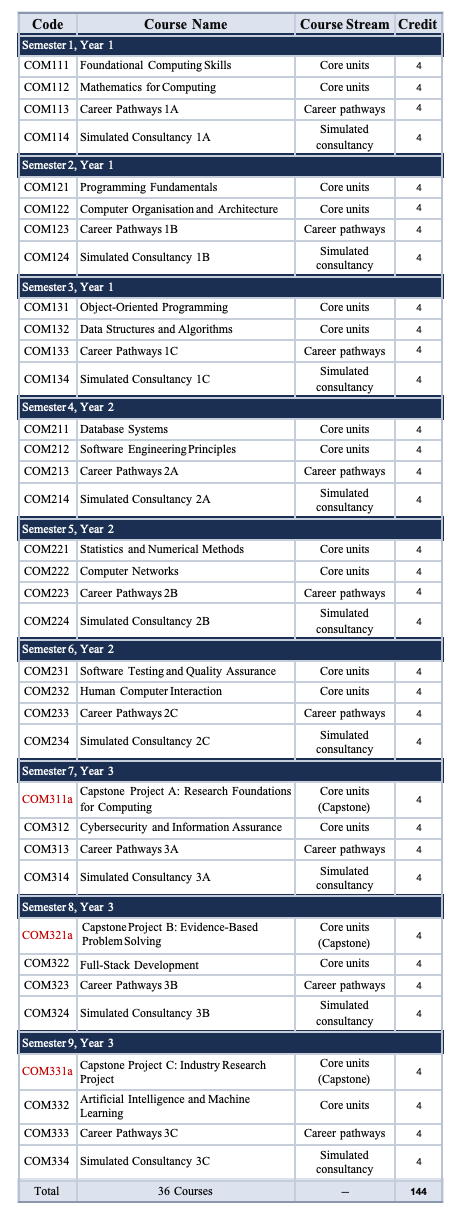
The three-year degree program consists of 9 semesters on a trimester system, with each semester lasting 12 weeks:
·Weeks 1–10: Regular instruction
·Week 11: Assignment / E-portfolio submission
·Week 12: Examination week
Students take a fixed load of 16 credits per semester, comprising 4 courses (4 credits each). The curriculum includes:
·2 Core Units (Theoretical learning)
·1 Course Career Pathways (Guidance on career directions and professional development)
·1 Simulated Consultancy (A simulated practicum combining academic and industry resources).
*During Semesters 7 through 9, one of the core units will be a Capstone Project.
The Capstone Project is offered in two formats:
i.Academic Research Project: Students complete a research project in their specialized field under the supervision of a faculty advisor.
ii.Industry-Partnered Project: Students complete a project based on real-world R&D challenges through a joint university-industry supervision model.













 Back


 公安备案号:31010702003342